


For people who love reading online novels, the name Tomato Novel must be familiar. When I first used this app, my impression was simple—it’s a free novel reading tool that doesn’t require paying for each chapter to unlock. But when you open it again in 2026, you’ll find it’s no longer just about reading text: besides abundant online literature content on the homepage, it also integrates various functions like audio books, short dramas, manhua adaptations, community interaction, and recommendations for novels when you’re stuck (book famine), making it more like a comprehensive entertainment platform centered around online novel IPs.
For users in Taiwan, the best thing about using Tomato Novel is that you don’t have to bother researching Mainland China accounts or randomly finding APKs to install like in the past. Now you can directly download the official version from Taiwan’s App Store, and the overseas version is also available on Google Play. However, note that the Taiwan version and the Mainland version don’t have exactly the same functions: things like comment sections, book recommendation squares, reward coins, and some community functions may differ depending on your account or region.
When reviewing reading apps, what I value most is not just “how many books are included,” but three core things: whether finding books is quick and easy, whether ads frequently interrupt your reading, and whether a novel suddenly starts charging once you get hooked. The most prominent feature of Tomato Novel is that it includes a large number of legally published online novels in its free reading range. It builds its business model through multiple methods like ads, membership services, and IP adaptations, which is where it differs from other platforms.
Next, I’ll cover everything from download channels, notes for users in Taiwan, novel categories, the AI audio book function, short drama content, coin rewards, to author earnings and privacy security, helping you figure out if Tomato Novel is worth installing in 2026.

I. Overview and Brand Background of Tomato Novel App
A. Free Online Literature Platform Under Douyin
Currently, Tomato Novel is clearly marked as a “Douyin-owned” free reading product on all major app store pages. Its core focus is providing massive amounts of legally published novels for free. Its biggest competitive advantage is not just the large number of contents, but also its ability to connect with the entire content recommendation ecosystem like Douyin, Toutiao, Hongguo Short Dramas, breaking the content limitations of a single platform.
If you’ve used traditional online novel platforms like Qidian Chinese Network or Jinjiang Literature City before, you should easily feel that Tomato Novel’s business model is very different from theirs.
The common model for traditional platforms is: they offer some chapters for free, and then you have to pay per chapter for the rest.
Tomato Novel has completely changed the core model: readers can watch for free, the platform earns revenue through various commercial methods like ads, and then shares the profits with the authors.
The biggest advantage of this model is that it lowers the user’s threshold. After all, online novels often have two to three million words. If you have to pay extra for every chapter, many casual readers might give up halfway. Tomato Novel is more suitable for users who think: “I don’t know what to read today, let’s just find a fun novel and finish it first.”
B. Launch Time and Development History
The product line of Tomato Novel gradually took shape around 2019, when ByteDance was actively expanding into the free reading market. In April 2020, the original novel channel of Toutiao was officially renamed “Tomato Novel”, and at that time, the independent app had already surpassed 10 million daily active users.
Looking back at its development over the years, it’s quite interesting: at first, people used Tomato Novel just to read free novels. Later, it gradually added functions like audio books, community interaction, chapter comments, author interactions, short dramas, comics/manhua adaptations. By the 7.x version in 2026, the app’s update notes even directly stated “optimization of reading, audio book, and drama viewing experiences”. You can clearly feel that the product’s positioning has shifted from a simple reading tool to a comprehensive content platform.
II. Download and Installation Guide for Tomato Novel
A. Download Steps for iOS, Android, and APK
iPhone or iPad users find it most convenient to install: just open the App Store and search for Tomato Novel. Currently, on Taiwan’s App Store, you can find “Tomato Novel – Popular Short Dramas, Full Novels, Ebook Reader”, developed by Beijing Zhending Technology Co., Ltd. As of August 2026, this app in Taiwan A
The App Store rating is around 4.8, with over 7,000 reviews, and it ranks high in the Books category rankings. For installation, iOS users need version 14 or higher. As for Android users, just open Google Play.
When searching for Tomato Novel on Google Play, you need to pay attention to version differences, okay?
Taiwan's Google Play currently has the overseas version available, with the corresponding package name:
com.dragon.read.oversea.gp
As of the version in July 2026, Google Play shows the app has accumulated over 500,000 downloads.
For those looking for APK files to install, I actually don't recommend choosing this method first.
Since you can download directly from Google Play, just use Google Play first.
If you really have a situation where your phone doesn't have Google Services Framework and you have to use an APK file, at least make sure the source is official or a trusted app store.
Like these APKs:
"Tomato Novel Unlimited Coins Version", "Member Cracked Version", "Permanent No-Ad Version"—all are highly not recommended to try.
Reading apps will access your phone number, reading history, account information, and even payment details. There's really no need to risk your main account for a few less ads by using a modified version.
B. Installation Notes for Users in Taiwan and Overseas
Taiwan users don't actually need to rush to turn on a VPN just to install Tomato Novel.
Because you can already search and find the official version on Taiwan's App Store and Google Play.
If you can't find it in the store, we recommend checking these things first:
Your Apple ID or Google Account's region setting, your phone's OS version, device compatibility with the app, and the store's cache status—instead of switching the store region to mainland China right away.
The real thing to watch out for isn't whether you can install it smoothly, but the overseas version may have fewer features.
For example, recent feedback from Taiwanese users on App Store and Google Play has reported that features like the comment section, Book Shortage Plaza, and some community functions don't work properly with overseas accounts. These issues are more related to server-side feature differences and not necessarily caused by your network.
III. User Guide for Taiwanese Users: Usage & Region Unlocking
A. Download & VPN-Free Tips for Users in Taiwan
For Taiwanese users, the most practical "VPN-free method" is:
Directly use the version available in Taiwan's official app stores.
Don't overcomplicate simple things.
If you just want to read novels, listen to audiobooks, or watch the short dramas currently available on the platform in Taiwan, just test it with your regular network environment first.
However, if a function is clearly blocked due to account, version, or region restrictions, a VPN may not fix it, because the platform also relies on:
Account region, phone number, app version, and server-side permissions to determine which features are available.
So if you run into something like "can't see the comment section", switching between Japanese, American, or Singaporean IPs may not help at all.
My suggestion is to treat the overseas version of Tomato Novel as a "reading + audiobook + short drama" tool—you don't have to insist on every feature being exactly the same as the mainland China version.
B. Simplified/Traditional Chinese Interface & Translation Settings
This part needs to be very clear.
The official interface languages listed for Tomato Novel on Taiwan's App Store are still primarily:
Simplified Chinese and English.
That said, don't misinterpret "you can download Tomato Novel in Taiwan" as a full Traditional Chinese localization for Taiwan being available yet.
However, based on version update records from the end of 2025, the reader has added Traditional Chinese display support.
So you might run into this situation:
The home page and buttons are still in Simplified Chinese.
But when reading novel content, you can display it in Traditional Chinese.
If you're more comfortable reading in Traditional Chinese, go into the novel reader's settings to see if there's an option to switch to Traditional Chinese.
I personally think that as long as the main text can be converted to Traditional Chinese, it doesn't make much difference to actual reading—though the interface localization is still not as complete as native reading apps in Taiwan.
IV. Content Genres & Popular Categories Overview
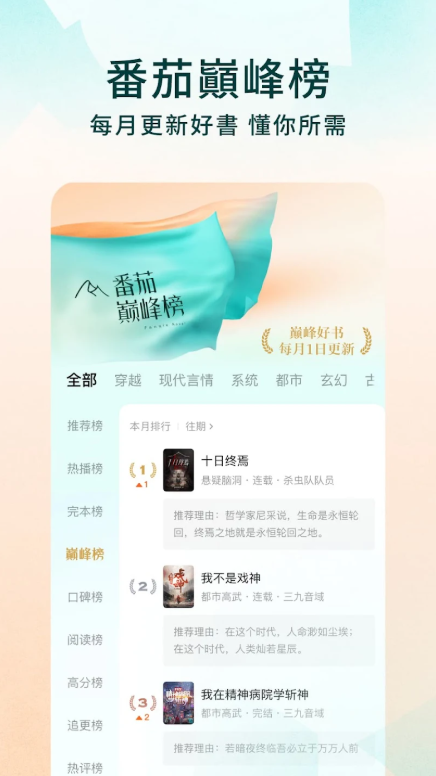
A. Urban "Feel-Good" Novels, Romance & Time-Travel, Fantasy & Cultivation
Tomato Novel is the best
These parts are still typical web novel content.
Popular genres for male readers include:
Urban imaginative stories.
Xianhuan.
Cultivation novels.
Historical fiction.
System novels.
Rebirth novels.
Apocalyptic novels.
Game novels.
Popular genres for female readers include:
Modern romance.
Historical romance.
Transmigration.
Rebirth.
Works with rich, domineering male leads are some of the top picks for many web novel fans.
Period dramas with a specific historical setting have gained huge popularity lately, as they often resonate strongly with readers.
Sweet, cozy romance stories are perfect for a mood boost—they’re packed with heart-fluttering moments that leave readers feeling happy.
Stories featuring strong, independent female leads are really eye-catching, delivering a highly satisfying, wish-fulfilling reading experience.
If you love web novels that kick off with exciting plots in the first three chapters, Tomato Novel is super easy to get into.
Unlike traditional published novels, it doesn’t require spending dozens of chapters building the world slowly—its pacing is tight and straight to the point.
Many popular works jump straight into the main plot in Chapter 1, such as:
Conflict points like the protagonist’s rebirth, broken engagement, transmigration, system activation, being kicked out of the house, or identity reveal almost always show up right at the start.
For fans who love this fast-paced, wish-fulfilling style, it’s super easy to keep reading chapter after chapter.
B. Wuxia Worlds, Mystery & Suspense, and Original Works for Dramas
Of course, Tomato Novel isn’t just about wish-fulfilling stories.
On the platform, you can find works in many other genres too:
These include mystery & suspense, wuxia adventures, realistic contemporary stories, sci-fi fantasy, historical epics, published books, and tons of original works adapted into TV dramas.
When I pick books, I rarely rely only on the "Popular Rankings"—they tend to push the same type of formulaic works over and over, which gets boring fast.
A more effective approach is:
First pick your favorite genre, then check the completed works list, high-rated lists, or reader reviews—this way, you’ll easily find a great book that actually suits your taste.
V. Short Drama & Web Novel Ecosystem
A. Huge Library of Short Dramas & Genres
When you open Tomato Novel in 2026, one of the biggest surprises for long-time users will be:
The short drama library has grown so much!
The official app store has already listed "huge short drama library" as one of the platform’s core features, with content covering genres like urban action, sweet romance, workplace & marriage stories, underdog comebacks, and defying fate.
The updated platform homepage has also added dedicated entry points for watching dramas and manhua to help users find what they want quickly.
From an app usability perspective, this design makes total sense.
For example, if you just finished a book like *The Female Lead’s Comeback After Divorce*, the platform’s algorithm will automatically recommend short dramas adapted from similar stories.
For the platform, a single story’s IP doesn’t have to only earn revenue from written content.
This IP can be developed in multiple forms: from written novels, short dramas, manhua, audio books, comics, and later even full TV dramas.
B. Novel IP Adaptations into Short Dramas & Drama Collaborations
This is also one of the most notable development directions for Tomato Novel in recent years.
It’s no longer just a simple web novel platform—it positions itself as a source for IP creation and development.
The official copyright collaboration section now lists multiple copyright cooperation forms directly: drama adaptations, animation adaptations, short dramas, audio books, publishing, comics, games, etc. So far, many novels have sold their drama or animation adaptation rights.
By 2026, the platform will even have special short drama adaptation events and support programs for high-quality IPs.
So now, when creators make a hit novel on Tomato Novel, the most ideal goal isn’t just "this book has high readership"—it’s becoming the next IP to be adapted into a short drama, manhua, animation, or TV drama.
This development logic actually aligns with the promotion of Hongguo Short Dramas.
According to QuestMobile statistics, as of September 2025, the overlapping users between Tomato Free Novels and Hongguo Free Short Dramas exceeded 87.26 million, making the content closed loop of "reading novels to watching short dramas" quite clear.
VI. Audio Book Function & AI Narration Experience
A. Volcano Voice Technology & Realistic Voice Tones
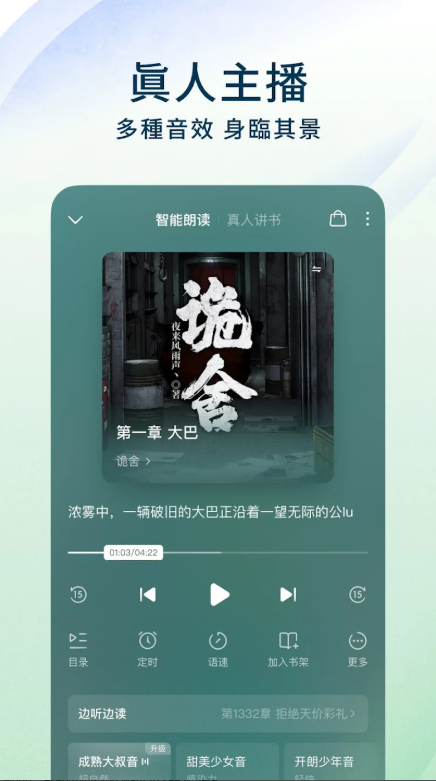
If you ask me which function of Tomato Novel is the most underrated, I’d definitely say the "Audio Book" feature.
The platform’s current AI narration is powered by the Volcano Voice team—no longer the kind of robotic voice from the early days.
Those stiff robotic voices—you know, the ones that stutter and sound completely emotionless, like reading it as “He. Walks. Into. The. Room.”—are really uncomfortable to listen to.
Today’s AI voice readers adjust to match the characters’ tones, speech rhythm, stress placement, and even the overall emotional arc of the story.
For me, the times I use the audiobook feature most are when I’m commuting on foot, riding in a car, tidying up my apartment at home, or lying in bed with the lights off right before sleep.
If you add half an hour of listening during your daily commute, you’ll make way more progress on a novel that would’ve taken you a whole week to finish reading.
B. Multi-character Voices and Immersive Audiobook Experiences
Another cool feature of today’s audiobook function is the multi-character voice setup.
The platform assigns unique voices to each character based on their background in the novel, which makes the listening experience more immersive and less likely to mix up who’s saying what.
For example, this AI audiobook adjusts voices for different characters: the male lead has a deeper male voice, the female lead has a distinct tone, and even elderly characters, children, and supporting roles each get their own unique voice.
The official team has also clearly labeled “new multi-character dialogue voices” as one of the core features of this AI audiobook.
That said, since it’s still AI tech, not a real human voice actor, it can sometimes sound a bit stiff or unnatural when it hits names, special terms, or passages with very complex emotions.
But compared to basic text-to-speech from a few years ago, the overall audiobook experience has improved by leaps and bounds—it’s a whole different level now.
VII. Free Reading Mode and Coin Reward System
A. Legitimate Free Reading and Ad Revenue Model
Tomato Novel’s most attractive feature has always been offering a huge library of legitimate novels to read completely for free, which is its biggest difference from other reading platforms that charge per chapter.
But “free” here doesn’t mean the platform has no commercial operations—you’ll still run into ads, paid memberships, ad-free plans, or in-app purchases.
Right now, on Taiwan’s App Store, you can find paid options like “Ad-Free Membership” and “Super Membership.”
So the more accurate way to put it is: most novels are free to read, and paying is mainly to get a smoother experience or unlock specific extra perks.
If you’re okay with occasional ads, you can totally use the free version first; if you actually spend 2-3 hours a day reading and get annoyed by the ads, then you can decide if you want to upgrade to a membership.
B. Earning Coins for Reading, Check-ins, and Bonus Features
Tomato Novel has always had popular daily activities: reading, daily check-ins, and completing assigned tasks to earn coins. Some versions also offer extra bonus events like inviting friends or watching videos.
But Taiwan and international users shouldn’t treat it like a “money-making app” right away—coin rules, withdrawal terms, and event eligibility can vary by version, account status, region, and even payment methods.
For example, the bonus page for the Chinese mainland version might not be the same as what you see on a Taiwanese account.
My advice is simple: grab the coins if you can, but don’t stress if you can’t—downloading old APKs or messing with your phone’s region settings just for a few coins is not worth the hassle.
VIII. Tomato Novel vs. Other Reading Apps
A. Differences from Traditional Paid Reading Platforms
When you compare Tomato Novel to traditional paid webnovel platforms, the differences are pretty clear.
Traditional paid platforms work more like readers paying directly to support content creation, and the conversion rate of paying for popular works is a key metric the platform cares about a lot.
Tomato Novel, on the other hand, lowers the reading barrier, attracts a huge user base with free access, and then makes money through ads, paid memberships, IP spinoffs, or other ecosystem models.
So the platform’s content style is also shaped by its business model—after all, free platforms care a lot about metrics like user open rate, follow rate, reading time, and retention rate.
This also means Tomato Novel’s works often get to the point faster; if the main plot isn’t unfolding in the first 10 chapters, readers will probably swipe away early.
B. Comparison to Short Drama/Novel Combination Apps
When compared to Hongguo Short Drama, the two have very different focuses.
For Tomato Novel, novels are the core, and short dramas are just a spin-off extension; Hongguo Short Drama
On the contrary, short dramas are the core, and novels are just one of the extension projects in the platform's ecosystem.
If you like to imagine character images and the worldview on your own through text, choosing Tomato Novel would be more suitable; but if you just want to quickly watch content full of twists during fragmented time like having meals, Hongguo Short Drama would be a more direct choice.
What's even more interesting is that the content of these two platforms actually diverts traffic to each other, and now they are increasingly like the same story IP, just two different consumption forms.
IX. Platform Data and Market Performance Analysis
A. Online Reading User Scale and Download Data
Tomato Novel's current scale is already beyond what ordinary reading apps can compare.
According to statistics from QuestMobile, as of September 2025, the monthly active users of Tomato Free Novel App are about 245 million, with a year-on-year growth rate of 11.4%, continuing to rank at the forefront of China's digital reading market.
The biggest significance behind this number is not "many people downloaded and used it", but
The free reading model has completely changed the ecology of the entire reading market. In the past, when many people mentioned "free novels", they often associated it with uneven quality or even pirated content, but today, free genuine reading platforms have become one of the core entry points of the reading market. Taking the Taiwan market as an example, although Tomato Novel's scale here is not as large as its main version in mainland China, as of August 2026, it still maintains a score of about 4.8 on Taiwan's App Store, and also ranks at the top of the book category rankings.
B. Ranking Performance and Revenue Overview
Tomato Novel has long occupied a top position in the book category of mainland China's App Store, and in August 2026 it was almost firmly near the top, with millions of accumulated ratings. As for the external curiosity about "how much money Tomato Novel earns a year", since the official has not fully disclosed the revenue of independent apps, it is actually not appropriate to use a single number spread online as an absolute reference. The currently confirmable revenue sources at least include: advertising revenue, membership services, in-app purchases, IP copyright authorization, and content cooperation. From the author's perspective, the revenue sources are more diverse, including revenue from reading and audio book sharing, revenue from gifts given by readers, channel sharing, and copyright revenue, which is also why free reading does not mean the platform cannot be commercialized.
X. Original Author Platform and IP Incubation Mechanism
A. Signed Works and Author Revenue Model
Tomato's appeal to authors largely comes from its traffic and sharing model. Current official author benefits include: exclusive shared signing, guaranteed payment/purchase, reading and audio book revenue, reader gifts, channel revenue, and copyright revenue. Among them, after deducting channel fees from reader gifts, authors can get a certain proportion according to the platform's rules; if the work later enters copyright cooperation such as short dramas, animations, film and television, publishing, comics, or games, it may also generate additional copyright revenue. The 2026 signing process provides an opportunity to apply for a signing evaluation after the work reaches the specified word count. For new authors, the biggest advantage is that the threshold is not as high as traditional publishing; you can start writing, accumulate reading numbers and readers first, and then slowly judge whether this book is worth continuing to invest in.
B. Super IP Film and Television, Animation Layout
Now, the "creation destination" of Tomato writers is no longer just publishing paper books. On the platform's official copyright area, you can directly see adaptation directions such as film and television, animation, short dramas, dynamic comics, audio books, publishing, and games. In 2026, the platform even launched a short drama special and IP adaptation incentive activity, directly sending popular online novels to the short drama or comic development pool. So from an industrial perspective, what Tomato Novel really values is not how many new books are added in the app today, but that it is gradually becoming "the first stop for stories": novels first verify themes and materials, then do audio books, then adapt into short dramas, then do comics or animations, and finally have the opportunity to become a formal film and television IP.
XI. Product Experience and Function Highlights
A. Interface Design and Reading Experience
Simply speaking as a reader, I think Tomato's work is not bad; common functions like fonts, font size, background, brightness, page turning mode, auto-reading, audio book, night mode are basically all available. And after the end of 2025, more reading backgrounds, fonts, and traditional Chinese reading support have been added one after another. However, the biggest controversy now is too many short dramas: recent reviews from some old readers reflect that the proportion of drama entries and short drama recommendations on the new version's homepage has increased, hoping that the platform can separate reading and short dramas more clearly. I can understand this too; if you just want to read novels quietly, the constant appearance of short dramas on the homepage does interrupt the rhythm a bit; but if you read both novels and short dramas originally, you will instead feel that the content is very rich and diverse.
B. Book Shortage Square, Book Circle and Community Interaction
In the past, there was always a problem when reading online novels: after finishing one book, you didn't know what to read next. Tomato has done a lot of community functions based on the demand of "book shortage",
For example, the Book Shortage Plaza, Book Circle Discussion Zone, Reader Interaction Zone, etc., let readers recommend good books to each other, exchange reading experiences, and solve the problem of not knowing what to read next. Apart from the novels themselves, this App also has functions like book recommendations from fellow readers, chapter reviews, and topic discussions.
The benefits it brings are far more than just simple chatting and interaction.
For example, when you're reading a novel and reach Chapter 300, a character suddenly appears, but you can't remember where he showed up before at all. If you check the chapter reviews at this time, chances are a netizen will immediately remind you: "This character first appeared in Chapter 72~" This kind of community feeling really makes the joy of following a novel a lot more enjoyable.
However, it seems that the overseas version still has some small issues. Many Taiwan users have reported that the Book Shortage Plaza, comment sections, and some community functions are not complete yet. So friends in Taiwan don't think that all the functions shown in the Mainland version screenshots will definitely be available for you to use.
XII. Security, Privacy, and Official Information
A. Developer Information and Privacy Policy
For the Taiwan App Store, the provider of Tomato Novel is:
Beijing Zhending Technology Co., Ltd.
This is Beijing Zhending Technology Co., Ltd.
As for the data safety page on Google Play, this App may collect various types of data such as location and personal information, and all transmission processes are encrypted. Users can also request to delete their own data.
Apple's privacy label mentions that the items involved may include:
Purchase history.
Phone number.
User content.
Search history.
Device and user IDs.
Usage status.
Diagnostic information.
Some identifiers may also be used for cross-App or cross-website tracking.
So my own principle for using it is simple:
If you just want to read novels, don't habitually turn on all permissions when you see permission requests.
Unnecessary permissions:
Location.
Album.
Notifications.
You can control them according to your actual usage situation.
B. Customer Service Contact and Usage Risk Tips
The official support email provided by Google Play is:
If you encounter issues in the App:
Crashing.
Login failure.
Reading record issues.
Member payment charges.
Content issues.
Please first use the in-App Help and Feedback functions.
Don't look for things online like:
"Tomato Novel internal customer service".
"Pay to restore account".
"Infinite coins cheats".
The following are a few practical usage safety reminders.
First, don't install APK files randomly.
Second, don't use coin benefits as a source of income.
Third, for auto-renewing memberships, confirm them on your Apple ID or Google Play subscription page; simply deleting the App does not cancel the charges.
Fourth, Tomato's current content is not only plain text, but also includes short dramas, user interactions, and some more mature themes. If parents let younger users read it, it's best to pay attention to the content rating. Currently, the Taiwan App Store marks it as 13+.
Let's Sum Up
After this period of testing, I think the 2026 Tomato Novel is no longer just a "free novel reader App".
If you just want to read novels, it really provides a large amount of genuine free content; you can basically find genres like urban fantasy, xianxia, romance, time-travel, suspense, and history, and you don't have to start paying per chapter halfway like on traditional paid platforms.
If it's not convenient to stare at your phone all the time, its AI audio book function is also very practical.
If you already love watching short dramas, the new version directly connects novels with short dramas and comics.
For content-focused users, one App allows you to switch from "reading novels" to "listening to novels" and then to "watching adaptations", so it's really easy to spend one or two hours using it.
As for Taiwan users, I think the biggest advantage is that downloading it is now very easy.
For iPhones, just use the Taiwan App Store.
For Android, just get it directly from Google Play.
Under normal circumstances, you don't need to research VPNs or Mainland China app stores at all to install it.
Truly
It’s important to accept that there are still gaps between the overseas version of Tomato Fiction and the mainland China version.
For example, the interface is still primarily in Simplified Chinese right now.
While the reader has added Traditional Chinese support, that doesn’t mean the entire app is localized for Taiwan.
Features like the comment section, Book Shortage Plaza, in-app coins, and some community tools might also be missing or restricted.
If your only needs are:
"I want to read lots of Chinese novels for free."
Then Tomato Fiction is absolutely worth trying. But if you value a fully localized Traditional Chinese interface, a Taiwanese book lover community, and content from local publishers, it might not be your only choice.
Also, I think the most interesting part of Tomato right now isn’t just what’s on the app’s surface—it’s the IP model behind it. A regular online novel can start as written text, then turn into an AI audio drama, short drama, manhua, anime, or even live-action films and TV shows. This approach of “testing a novel in the market first before expanding into other content formats” has made Tomato more than just a reading platform—it’s an entry point for the entire storytelling industry chain.
So if you’re just a reader, the biggest benefits of Tomato Fiction are:
Plenty of books, free access, and a fast pace.
If you’re a creator, what really draws you to it might be:
Traffic, revenue sharing, and IP adaptation opportunities.
One thing to be careful about, though—once you start using it, you might lose track of time. You’ll think you’ll just read two chapters before bed... Chapter 1: the protagonist is reincarnated. Chapter 2: the system awakens. Chapter 3: time for some comeuppance. Then you glance at the clock and it’s already 2 AM. That’s probably what makes Tomato Fiction so addictive—and why you need the most self-control with it.