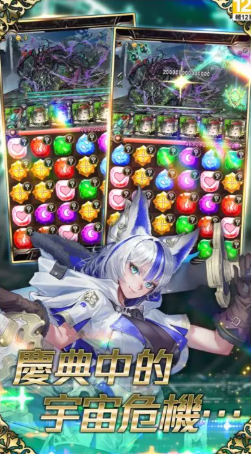
If you were a die-hard summoner for **Tower of Saviors**, took a few years off and came back, your first reaction probably won't be "the tile-swiping feels just like I remember". Instead, it'll be "OH MY GOD there's SO MUCH STUFF added now?!" Back in the day, everyone was sticking to teams like Norse Gods, Greek Gods, Beast Teams, Ranger Teams, and similar comps. Now, not only are there limited-time Black Gold characters and cross-franchise collaboration series, but also Ascension, Ultimate Fusion mechanics, Dragon Locket Weapons, EP Rare Characters, all sorts of new enemy skills, and a ton of team skills. Just reading the card descriptions is way more complex than it used to be—total whiplash for new players~
But honestly, the core gameplay of this game has never changed. Players still move tiles to land Combos, then take down enemies by matching attributes, using leader skill multipliers, character active skills, and stage mechanics. Because the structure—"tile-swiping gameplay + card progression + dungeon puzzle-solving"—is so replayable, **Tower of Saviors** has been running nonstop from 2013 to 2026, and still keeps releasing big updates and cross-franchise collabs. The game's currently on version 2026.5, and this August, they launched a brand-new limited-time Black Gold character: "Boundless Galaxy · Turing and Bermuda". That means players who search for **Tower of Saviors download** to come back for a playthrough will find a totally different game environment than they remember—super eye-opening!
Next, I'll break everything down from an actual player's experience—including download guides, PC version info, APK installation, beginner progression tips, tile skills, gacha tricks, Black Gold character reviews, collab character analyses, leader tier lists, dungeon strategies, glossary lookups, and inventory management—all in one easy-to-follow spot.
I. What is Tower of Saviors? Game Overview & History
**Tower of Saviors** is a tile-swiping card RPG developed by Hong Kong studio Mad Head. You play as a "Summoner", who gets characters, materials, and Magic Stones by clearing main story and event stages, building your own powerful team bit by bit.
What stands out most to players is definitely the game board made up of six different tiles.
Water, Fire, Wood, Light, and Dark are the five attack attributes, while Heart tiles are for healing HP. Unlike regular match-3 games where you only swap one tile at a time, here you can grab a tile, drag it within the time limit, swap all tiles along the way, and clear multiple groups at once to deal way more damage.
This gameplay looks simple at first, but the gap between new players and experts is huge.
New players might only clear 3 tiles at first, but once they get the hang of it, they'll start lining up 4-Combos, 6-Combos, or even full-board clears. Then you'll have to learn about first-clear damage, tile-stacking tricks, character-specific tiles, race bonuses, and how to counter all sorts of special shields—tons of depth here.
Since its 2013 release, **Tower of Saviors** has built a huge fanbase in Taiwan and Hong Kong markets. After years of running, its original lore has expanded from just mythological characters to a full main story, original series, limited Black Gold characters, and tons of cross-franchise collaborations.
So these days, it's way past the era where you could just max out Norse Gods and clear everything.
II. Tower of Saviors Download & Platform Installation Guide
A. iOS / Android Download Steps
If you want to do **Tower of Saviors download**, the easiest way for iPhone and iPad users is to open the App Store and search for "Tower of Saviors" directly.
Make sure the developer is listed as **Mad Head Limited**, then tap "Get" and finish your Apple ID verification. Right now, the game's base size on Taiwan App Store is about 698MB, it has a 4.3-star rating from around 110,000 reviews—but that's just the initial install. The character art, stages, and other assets will download on your device as needed, so it'll take up way more space than that total.
For Android players, open Google Play, search for "Tower of Saviors", and confirm the package is Mad Head's official version before installing.
Right now, the download count on Google Play has already passed 10 million, and they keep releasing updates for the Traditional Chinese version.
My own tip is that it's best to use Wi-Fi for your first install.
Because **Tower of Saviors** has so much character art, Dragon Locket Weapons, collab materials, and stage content now—playing while downloading over cellular data will give you a bad experience. The game also has an option to pre-download all assets in the settings, so if you plan to play long-term, you’ll want to
Downloading it first is actually more hassle-free.
B. PC Version & APK Installation Guide
Back in the day, if you wanted to play *Tower of Saviors* on PC, your go-to move was usually an Android emulator like BlueStacks, MuMu, or LDPlayer.
Things are different now.
The Windows version of *Tower of Saviors* has actually been available on the Google Play Store for a while now, and players can install it via Google Play Games on PC. If you just want to play on a big screen, I personally would recommend using the official Google Play PC environment over third-party emulators.
That’s not to say you can’t play using third-party emulators at all, but the official FAQ has never listed emulators as a recommended environment. Plus, using an emulator might mess with your leaderboard scores, guild event points, and even some tournament-related features!
If you’re just casually farming materials, you probably won’t notice a difference, but if you’re serious about competing in leaderboards or tournaments, this is something you can’t ignore.
As for the APK version, *Tower of Saviors* still offers an Android APK. The official installation process is pretty straightforward: first, download the APK file, then on your phone, allow your browser or file manager to install apps from unknown sources, and you’re good to go.
But a heads up: only get the APK from official download channels to stay safe.
Under no circumstances should you install a modified version just to get things like "infinite Magic Stones" or "guaranteed Black Gold units". For an account-building game like this, if your account data or device security gets compromised, the loss will be way bigger than a few gacha pulls.
III. Version Differences & Server Segmentation for Tower of Saviors
A. Comparing Taiwan Server and Tencent Mainland China Server
This is one of the parts where new players often get confused by old info when searching for resources.
The "Taiwan Server" everyone talks about usually refers to the Traditional Chinese service that’s still running today. Back in the day, there was also a Simplified Chinese version for mainland China operated by Tencent, which was what people used to call the "Chinese server".
But this Tencent-operated mainland China version officially ceased operations on October 22, 2015, and the servers have been shut down for a long time. Right now, there’s no active Tencent Chinese server that competes or updates alongside the current Traditional Chinese version.
So in 2026, if you come across old online articles that say "Tower of Saviors Chinese server download" or "Tencent version APK", don’t just download and install them right away.
If you want to play the latest content properly, the key is to use the version still operated by Mad Head.
Also, keep in mind that collab events are sometimes restricted by region due to licensing. For example, the 2026 collaboration with *The Irregular at Magic High School* was only available to players in parts of Taiwan, Hong Kong, Macau, and Southeast Asia.
That’s why players in different regions sometimes notice that event pages look different.
B. Latest Version Update
As of August 2026, *Tower of Saviors* has been updated to version 2026.5.
This update isn’t just a gacha pool refresh—it also adjusted the skills of many old characters, including Enoch, Ingrid, Melody, and Cassiel. It also improved the classification and filtering for Dragon Engraves, and added useful features like collab/non-collab character filtering and blacklist management.
The most anticipated new unit by players during this period is of course the brand new limited Black Gold character:
Boundless Galaxy ‧ Turing and Bermuda.
She’s a key core for the Machine and "Overlimit Tech" archetypes. As a captain, she has a ton of shield-piercing abilities, extended orb-matching time, orbs that combine multiple types, fast skill activation, and survivability—she’s definitely one of the top-tier units in the second half of 2026.
The biggest difference veteran players notice with these units is: "Back in the day, we brought units just to break shields. Now a lot of new captains come with tons of shield-breaking abilities built right in."
IV. New Player’s Guide to Tower of Saviors
A. Basic Systems & Stamina Mechanic
When you first start the game, new players don’t need to rush to research all the event pages right away.
Just get the hang of three things first:
Stamina, Magic Stones, and your team.
Stamina is mainly used to enter various dungeons. Your stamina cap increases as you level up your Summoner Rank. Events also often give out Stamina Potions, so you don’t need to burn a bunch of Magic Stones to refill stamina early on.
Magic Stones are one of the most important resources, both free and paid.
They’re used for gacha pulls, expanding your inventory, and in some cases, reviving or getting other essential things
Other resources.
One of the biggest regrets new players have is wasting Magic Stones to refill Stamina as soon as it runs out in the early game.
My advice is:
Save your Magic Stones for banners that are actually worth pulling on.
Focus on clearing the main story first too — lots of features and resources unlock as you progress.
B. Team Building Concepts & Character Training Order
In Tower of Saviors, a team is usually made up of a Leader, 4 team members, and a Support Friend.
The Leader Skills of you and your Support Friend directly determine your team’s damage multiplier, HP, Recovery, how your orbs match, and if you can break certain special shields.
So for new players, don’t start with “Which 6 characters do I have with the highest stars?” Instead, ask: “What kind of Leader Skill do I need for my playstyle?”
Each Leader has specific requirements for their team members — there’s a lot to learn here.
Some Leaders only activate their effects if the team is made up of Pure Human characters.
Others are built for Machine teams, so only Machine members get the buffs.
There are even stricter rules: only 2 specific attribute characters in the team can get the full damage multiplier boost.
Don’t think throwing 6 “strong-looking” characters into a random team works — you might end up with only 2 characters getting the Leader’s main multiplier, wasting the value of all your other good cards.
When it comes to training characters, here’s my personal order of priority:
Max out your main team’s Leader first → Next, core characters that can break key shields → Main damage dealers → Support/utility characters → Finally, collectible characters.
Don’t rush for speed — wait until your first full team can consistently clear stages before you start training for a second team, that’s way more reliable.
V. Orb Matching & Attribute Weakness System in Tower of Saviors
Attribute relationships in Tower of Saviors are actually the easiest part for new players to remember.
Water beats Fire, Fire beats Wood, Wood beats Water.
Light and Dark, on the other hand, counter each other.
When a character attacks an enemy’s weak attribute, the damage output is way higher.
But with updates, you can’t just rely on attribute weaknesses to clear stages anymore.
That’s because many new Leader Skills have effects like ignoring attribute weaknesses, additional hits, or auto-orbs. So what really decides if you clear a stage is the enemy’s special skills.
Here are some examples of common enemy skills:
Combo Count Limit Shield
Pre-Attack Shield
First-Orb Counter
5-Attribute Shield
Shape-Specific Shield
First-Orb-Count Shield
Fixed Combo Count Shield
Orb Curse
Slime Rot & Burn
This is why many new players later realize: Orb matching skills are just the first barrier to clearing stages.
The real challenge is understanding what the stage actually requires from you — that’s the second core barrier.
For example, if an enemy has “First-Water-Orb Counter” on it, and you clear Water orbs on your first turn, even if your Leader has a huge multiplier, your attack will be countered and wasted.
VI. Summon & Gacha Guide for Tower of Saviors
A. Summon Mechanics & Gacha Rates
The main resources for summons are Magic Stones, or event-exclusive Summon Tickets you can get for free.
But there’s a super important concept in Tower of Saviors that’s easy to miss:
Rules for each banner are NOT the same.
Don’t assume that all gacha banners have fixed rates for rare characters or pity counts — every event banner has different rules.
For example, the 2026 “Witches’ Eternal Night I” banner had a total rare character rate of 7%, with a 6% rate for the featured Pick Up character. The “The Irregular at Magic High School” collab banner used a system where you get a guaranteed rare character at 35 pulls, and some “Black Gold” events have a guaranteed rare at 40 pulls.
So before you summon anything, the first things I check are:
Who is the main prize of this banner?
How many pulls for pity?
Are there any rate-up days?
Can secondary prizes be exchanged?
What do you get for hitting a certain number of pulls?
New players, don’t just go for a 10-pull because a character looks cool — check these details first, it’s way more reliable.
B. Limited Black Gold & Banner Series Introduction
The so-called "Dark Gold" units are easily the most iconic high-rarity limited characters in *Tower of Saviors* and top-tier picks that tons of players chase after.
Whenever a Dark Gold unit arrives, it always brings a brand-new team mechanics, paired with exclusive summon banners, Dragon Locket gear, and even event dungeons to match.
Some of the notable Dark Gold units in 2026 include:
All-Dharma Root Mind ‧ Alaya-Vijnana
Supreme Dragon Thunder ‧ Indra
Fate-Bearing Vessel ‧ Genghis Khan
Boundless Star River ‧ Turing & Bermuda
Alaya-Vijnana and Indra, released earlier this year, already came with extremely high attack and HP multipliers plus full team skills; by the time Turing & Bermuda dropped in August, their Leader Skill further integrated a lot of enemy skill nullification, recovery, cooldown reset effects, and supports Machine-Type teams, pushing their power to a whole new level.
My personal gacha pull rule is super straightforward:
If you're a free-to-play (F2P) player, never waste your Magic Stones on every 10-pull banner just to test your luck — you'll run out way too fast.
It's better to save your Magic Stones and only pull when you're actually able to hit the pity system; this will make your account way more consistent in strength.
VII. Tower of Saviors Collaboration Event Unit Roundup
Collaboration events have always been one of the most attractive parts of *Tower of Saviors*, with past crossovers with tons of popular anime and novels.
Old players definitely remember the collabs we did with classic IPs like *Demon Slayer: Kimetsu no Yaiba*, *Hunter x Hunter*, *Yu Yu Hakusho*, *Gintama*, and *Sword Art Online*; 2026's collabs are even more frequent, with new crossover waves non-stop.
Here are the big collabs we've had this year alone:
Solo Leveling
Dandadan
Mushoku Tensei: Jobless Reincarnation
The Irregular at Magic High School
This *Irregular at Magic High School* collab banner features popular characters like Tatsuya Shiba, Miyuki Shiba, Mayumi Saegusa, and Angelina, plus an Ultimate Merge version of Tatsuya Shiba too! Now, are these collab units worth pulling for? I usually judge on two key points: First, can this collab unit function as a Leader to build a complete team on its own? Second, will it be extremely hard to get substitute units after the collab ends? After all, the biggest headache with collab units is that their rerun timelines are totally uncertain. If a key member is only available during the collab period, you might have to wait forever to get them again later — that's brutal.
Are collab units worth pulling? I usually look at two things. First, can the Leader form a complete team independently? Second, will it be hard to get substitute units after the collab ends. The biggest downside of collab units is their uncertain reruns. If a key unit is only available during the collab period, you might really have to wait a long time to get it later.
VIII. Tower of Saviors Leader System & Tier Recommendations
A. SS-Tier Leader Recommendations
To be honest, Leader tier lists shift with the meta — no list is set in stone. But based on the current meta as of August 2026 and how complete their skills are, I'll group these types of Leaders into "SS-Tier / Top-Tier Picks" for discussion.
Boundless Star River ‧ Turing & Bermuda
Boundless Star River ‧ Turing & Bermuda is easily one of the most talked-about new Dark Gold units right now. Her biggest selling point isn't just raw multiplier numbers — it's that her Leader Skill and Team Skill almost wrap up every single thing you need: damage boosts, orb management, HP recovery, shield breaking mechanics, skill cooldown reduction, plus activation conditions for Machine-Type members. If you happen to have a full Transcend Tech team or a full Machine-Type squad on your account, her potential is insane — she's perfect for clearing high-difficulty dungeons.
All-Dharma Root Mind ‧ Alaya-Vijnana
All-Dharma Root Mind ‧ Alaya-Vijnana has extremely high HP boost multipliers, and offers solid support for Water, Light, Dragon, Demon, and Endless Void members. Most importantly, her skill mechanics flow super smoothly — her skill rotation feels great, and she's really adaptable no matter what tricky stage you face.
Supreme Dragon Thunder ‧ Indra
Supreme Dragon Thunder ‧ Indra's thing is that he needs high Combo output, but he's super survivable too, plus has a shield counter mechanism. If your orb-rolling skills aren't 100% consistent, his team mechanics give you a lot of leeway — you don't have to stress too much over mistakes.
Fate-Bearing Vessel ‧ Genghis Khan
Fate-Bearing Vessel ‧ Genghis Khan is another unit released in 2026.
Black Gold units are super valuable for Beast-type teams and related lineups. But I gotta give you a heads up – an SS-tier unit isn’t always the fastest pick for every dungeon. After all, Tower of Saviors’ high-difficulty stages are often designed to counter specific team mechanics, so it’s best to have at least two to three different types of main teams ready for all kinds of situations.
B. Solid-Color vs. Multi-Color Team Combinations
Next up is the combination advice for B. solid-color and multi-color teams. A solid-color team is one where all members share the same element – like a water team full of water units, or a fire team full of fire units. Their advantages are that it’s easier to concentrate resources on damage boosting, orb matching, and equipment, making them less of a grind to level up. Multi-color teams, on the other hand, might mix all five elements, or combine specific races or series. New team leaders these days almost have multiple functions, so multi-color teams are way easier to handle than in the early days of the game – no need to worry about being too hard. When building a team, don’t just look at "element"! Also consider: race, series tags, EP/CD system, active skills, and shield-clearing ability. Actually, a truly good team isn’t just six damage dealers – it’s a team that can handle whatever kind of shield the enemy throws at you. That’s what you’re going for.
IX. Analysis of Famous Character Series in Tower of Saviors
If you’ve been playing Tower of Saviors for a while, you’ll notice that many character series mark different eras of the game. For example, in the early days:
Norse God Series – Characters like Freyr, Tyr, Freyja, etc., were the faces of solid-color teams back in the day.
Greek God Series – Poseidon, Hephaestus, Athena, etc., are famous for their orb-matching and drop mechanics.
Chinese God Series – Includes classic characters like Ao Guang, the Third Prince, Daji, etc.
Babylonian Deities, Egyptian Gods, Zodiac Signs – These are also series that many long-time players really cherish.
After the game entered the Black Gold era, character design started emphasizing more on "one leader builds an entire team ecosystem." Add collab characters into the mix, and now the collectible value of an account isn’t just about strength anymore. Some old cards might not be top-tier in actual combat, but because they’ve been with you for years, you’d never want to fuse them away. That’s the kind of feeling only old games give you.
X. Tower of Saviors Dungeon Challenge Guide
Dungeons are roughly divided into Main Story, Biweekly, Hell-level, Nightmare-level, Monthly Challenges, Arena-related, and various limited-time special stages. For new players, the most important thing isn’t memorizing "which team is the strongest" – it’s learning to check the info before entering. Every time I tackle high-difficulty content, I usually do four things first:
First, check element and race restrictions. If a dungeon only allows God-type characters, bringing a human top-tier leader is pointless.
Second, check if skills are locked or reset. This is super important! If the dungeon locks your active skills or resets skills every turn, you need to quickly adjust your skill-reliant team – don’t bring the wrong team at all. If the skill reset mechanic starts on the first floor, you’ll need a team that can reduce skill cooldowns, or a setup that can survive early waves without using skills.
Third, pay attention to major shield mechanics.
Things like counter-first-orbs shields, fixed Combo shields, five-element shields, and T-shape shields – it’s best to plan your countermeasures during the team-building phase.
Fourth, confirm the team’s revival ability.
Many Nightmare-level or Challenge dungeons don’t even allow reviving with Magic Stones anymore. High-difficulty content isn’t just about comparing damage numbers – it’s more like "bringing six cards to solve a set of mechanics puzzles."
XI. Tower of Saviors Card Collection & Skill Lookup
As more characters are added to the game, the importance of the Card Collection and character filtering features has stepped up a lot. You can use in-game search and filter tools to quickly find the characters you want by element, race, series, rarity, skill type, collab or non-collab, and ownership status. The 2026.5 update also added extra filter options for "collab" and "non-collab", and Dragon Locks have more detailed equipment requirements, skills, and recommended categories – super useful for long-time players’ accounts. My go-to method is to look for characters by function, for example, if a dungeon needs a pre-attack shield counter, I don’t have to dig through thousands of cards by memory – I can filter by skill info to find it fast. There are way too many cards now, so just memorizing character skills alone isn’t enough. Also, when you see an unfamiliar character, make sure to open their card details to check: leader skill, active skill, team skill, bond effects, Awakening System, Dragon Lock requirements, and more. Many characters might seem ordinary just by looking at their active skill, but when in a team with a specific leader, the team skill can suddenly add several super useful effects.
XII. Tower of Saviors Backpack & Material Management Tips
New players will quickly face a frustrating pain point: Backpack Overload. There are tons of materials, characters, skill-up cards, event cards, and collectibles in the game. If you never organize things, even finding the exact card you need will turn into a total hassle after a while. My go-to organizing habits are: Add rare characters to Favorites immediately; lock all limited collaboration characters; you must lock Dark Gold rarity characters; keep at least one Hell or Nightmare boss card; for duplicate gacha characters, check if they have potential uses like Awaken, Break, Trade, or others. Don’t decompose duplicates right away—especially collaboration ones. They might look useless now, but that doesn’t mean a power-up function won’t launch half a year later. For skill-up materials, use them based on the team you plan to train soon. Don’t feed two Monster Birds to a Water attribute character today, then three to a Dark attribute one tomorrow, leaving none of your main team’s characters fully skill-maxed. Also, high-level summoners can now expand their backpack to a massive capacity, so long-term players don’t have to stress about "no space". The key is to build a regular organizing habit.
XIII. Tower of Saviors Player Reviews & Community Discussions
Looking at major app stores, Tower of Saviors has a super interesting score gap: Taiwan’s App Store currently holds around 4.3/5 stars (over 110k total reviews), while Google Play’s Taiwan page has around 3.1/5 stars (more than 800k comments). This lines up with what I’ve observed in player chats: Fans of this game usually praise a few core points. First, the tile-matching system has a unique feel. It’s hard to find another card RPG that uses similar mechanics and has run continuously for over a decade. Second, there are tons of IP collaborations—many players even come back just for a specific anime collab they’re hyped for. Third, old characters won’t be abandoned. Through Ultimate Fusion, Dimensional Reincarnation, Awakenings, or skill tweaks, old characters can get reworked to become viable again. Of course, flaws are clear too: Current skill descriptions are super long. When a new player sees a modern Dark Gold card for the first time, they might have to scroll forever just to read the team skills, meaning the info load to get started is way bigger than before. Another issue is that power updates for versions are really fast. If you care a lot about top damage each season, you’ll easily end up chasing new non-stop. So I recommend casual players to stick to 1 or 2 teams they actually love, clear most events, and don’t need to max every card in the box. For the community, Tower of Saviors has always had a mature guide culture—once a new Nightmare level drops, different team clear methods usually pop up super quickly. When you hit the endgame, you’ll realize understanding "why the enemy uses this skill on this turn" is way more useful than copying someone else’s team directly.
Let’s Summarize
Overall, whether you joined this year or are a returning veteran, the Tower of Saviors download threshold isn’t about installation—it’s about re-learning the current changes to characters and level environments.
For installation: iPhone and iPad work directly via App Store; Android users prefer Google Play, and there’s also an official APK option. Windows PCs can play via Google Play Games for PC, and if you use third-party emulators, watch out for limitations on some leaderboard and event features.
After logging in, new players shouldn’t rush to study thousands of cards right away.
First, find a solid team leader, then build a full team around their attribute, race, and series requirements. Don’t waste Magic Stones on Stamina restores or pulling banners to test cards—save them for when Dark Gold drops, collab events, or card boxes that optimize your account, and invest strategically based on the pity system.
If you’re a player returning in August 2026, the most standout new unit is the brand-new Dark Gold character "Vast Galaxy Turing & Bermuda". Characters released in 2026 like Alaya, Indra, Genghis Khan, etc., also represent the modern Tower of Saviors team leader design: the multiplier is just the base—what’s powerful is the full integration of survivability, shield-breaking mechanics, skill rotations, and team system.
But I think the most charming part of Tower of Saviors isn’t pulling the latest Dark Gold card.
What keeps players sticking around long-term is the process: when facing a totally confusing Nightmare level for the first time, slowly figuring out enemy skill mechanics, digging through your backpack to pick characters, re-adjusting your team, and carefully placing every tile yourself.
When the board clears gradually, the enemy’s HP hits zero, and that "Oh, this is how to beat this stage" aha moment—this is still the core charm that’s kept Tower of Saviors running for over a decade, bringing old players back again and again.