Jujutsu Kaisen: Phantom Parade 2026 Latest Character Tier List Guide
Whether you’re a newbie who just started playing *Jujutsu Kaisen: Phantom Parade* not too long ago, or a veteran who’s been in the game for ages but now starts panicking over every new banner, limited character, or event—wondering who to pull, who to level up, or if you should dump your resources—right now what you absolutely need isn’t a stronger urge to pull more, but a **character tier list and build guide** that actually puts players first and gets the current meta right.
At first glance, *Jujutsu Kaisen: Phantom Parade* looks like a standard anime-based turn-based RPG, but once you play it for a while, you’ll realize it’s nothing like those games where you just throw any SSR character into your team. The official global website and store pages make it super clear: this is a turn-based party RPG built on the *Jujutsu Kaisen* anime world, featuring full-voiced storylines, free team building, and requiring jujutsu techniques and physical attacks to exorcise tough foes. There are also systems like **Domain Investigations** and **Imaginary Residues** that really amp up the depth of team building. In other words, **a character’s strength never depends on stats alone—you have to see if they actually fit well into your team and bring real value to it.**
What makes things even trickier is that judging character strength in *Phantom Parade* depends on three key factors. First, **the Japanese server and global server have different update progress**, so a top-tier character in JP doesn’t necessarily work when you’re playing on TW or global servers right now. Second, the game’s **four attribute types: Phantom, Shadow, Night, Journey**—their weaknesses and resistances are no joke, picking the wrong attribute will directly kill your damage efficiency. Third, when players talk about the "strongest characters", they’re mixing up a ton of different scenarios: main story progression, high-difficulty raids, Dreamscape Tower, Domain Investigations, auto-battles, Score Attack, even what’s called competitive or rank-pushing play—but that’s not exactly the same as traditional real-time PVP. If you check GameWith’s latest info, you’ll see their main updates are now about top character lists, best team comps, four attribute rankings, auto-battles, and Score Attack. To put it another way, **the current meta in this game is essentially PVE-focused, extended to high-score, high-pressure, and high-efficiency environments.**
So this article isn’t just going to copy-paste a random Tier list for you. I’m coming at this from a player’s perspective, breaking down exactly how to look at the current version’s **Jujutsu Kaisen: Phantom Parade character rankings**: who are the T0 characters that feel amazing to pull right now, which T1 characters are super reliable but more dependent on team synergy, which characters are actually worth investing in for F2P players more than their rare rating makes them seem, how to understand those four attributes, what to prioritize between SSR and SR, who you should focus on pulling for your first roll and in the first three days as a new player, and whether you should follow JP server preview info or focus on your current global server’s resources first. This article will write like a player chatting, and I’ll separate "version facts" from my own player judgment as much as possible, so you don’t finish reading and feel like you got nothing useful.
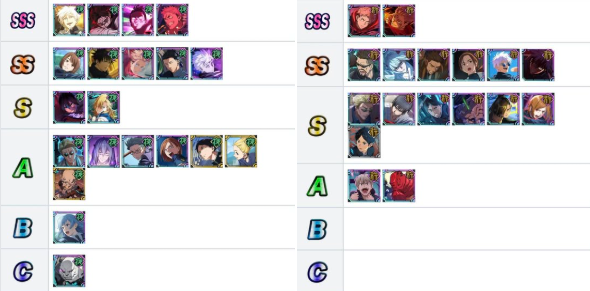
I. Foreword: Current Meta Overview for Phantom Parade
A. Shared Environment & Four Attribute Explanation for TW/Global Servers
Let’s start with the basics. The official global website and Google Play page for *Jujutsu Kaisen: Phantom Parade* define it as a turn-based RPG built on the anime’s world—you can re-experience the anime’s story, play the original Fukuoka School arc called *Phantom Parade*, and take on high-quality battles and content like **Domain Investigations** with your custom team. The global version is published by BILIBILI HK, launched in November 2024, got a PC version in August 2025, and its Steam page went live in January 2026. That means players on the TW and global servers have a way more complete experience than the original Japanese server, plus way more sources of info to check.
In the battle system, the four attribute types are really super important. GameWith’s explanation of the attribute system states that damage skills come with one of four traits: Phantom, Shadow, Night, Journey, with the **Phantom and Night being each other’s weaknesses, Shadow and Journey being each other’s weaknesses**. Game8 explains it in simpler terms: hitting an enemy’s weakness deals about 1.5x damage, while hitting their resistance drops it to around 0.75x. This means the four attributes in *Phantom Parade* aren’t just for aesthetics—they directly determine your main carry’s damage efficiency across different stages. If your main damage dealer hits a resistance by accident, even with high stats, your gameplay will feel like it’s...
They fall way behind.
So I've always felt that the character rankings in *Jujutsu Kaisen: Phantom Parade* shouldn't just focus on "who's the strongest" — they should look at who excels in various scenarios — characters that can perform no matter the attribute environment, get super strong when paired with a favorable attribute matchup, and are top-tier damage dealers that feel really awkward to use when countered by an enemy's attribute. That's why a single character's ranking can vary so much between the overall tier list and attribute-specific tier lists. For example, Gojo Satoru is universally known as an extremely powerful Shadow Attribute damage core, but if you try to use him on a stage with a conflicting attribute, the fun factor drops a lot. On the flip side, some versatile supports or high-quality SR characters might not look top-tier on paper, but because they don't rely too much on attributes and can work across different teams, they're actually way more practical for F2P players. This is exactly what sets this game apart from many card RPGs that only care about rarity.
B. Character Ranking Criteria: PVE Story Progression, Boss Battles, Semi-Competitive Ranking, and Convenience
First, I need to make my ranking criteria 100% clear. If you don't lay out the rules, any tier list will just turn into a big fan argument.
The first criterion is PVE Clear Speed. This includes the main story, daily events, and material stages. The key things here are how fast the character clears waves of enemies, how high their survival rate is, and whether they need time to "warm up" before using their skills. For example, GameWith's strongest team comp and beginner recommendations page clearly follows this logic, prioritizing characters with high practicality, those that work well for story progression, and those with high versatility.
The second criterion is Boss Battle and High-Difficulty Mode Performance. The official store page and major guide sites have already explained long, high-difficulty modes like "Domain Surveys" in detail, and GameWith currently puts high-intensity content like Sweep Battles and Score Attack in their core guide section. In these environments, it's not just about clearing waves of enemies anymore — you also have to consider single-target burst damage, destruction efficiency, Curse Energy cycle speed, sustainability, crucial control effects, and team buffs.
The third criterion I'll call Semi-Competitive and Ranking Environment. Let me make this very clear right now: the official core gameplay they advertise is still the story, team building, Domain Surveys, and various PVE events — not traditional real-time PVP arenas. But in reality, when players talk about character strength, they often use high-speed runs, Dream Corridors, Sweep Battle scores, and rankings from limited-time high-difficulty events as "competitive environments." So when I later mention PVP or ladder-like vibes, I'm basically referring to this high-pressure, high-efficiency, team-ceiling environment, not that this game is now focused on real-time player-versus-player battles. It's super important to clear up this difference first.
The fourth criterion is Convenience and Versatility. Some characters might not deal the highest damage every single time, but they can still help you progress the story, join events, tackle high-difficulty modes, and support other teams across different attributes. These characters are especially important for new players and light spenders. On the flip side, some limited characters have extremely high stat ceilings, but if you don't have their corresponding residues, haven't invested in their skills, or don't have a compatible team, the experience might not match their rarity. That's why I'll later emphasize that the "beginner-friendly ranking" is different from the "heavy spender-friendly ranking."
C. Different Reference Methods for New Players, F2P, Light Spenders, and Heavy Spenders in Strength Tier Lists
One of the easiest pitfalls in *Phantom Parade* is seeing others show off limited characters like Gojo Satoru, limited Sukuna, or limited Okkotsu, and immediately rushing to spend money on summons — only to find out later that your account doesn't have enough resources to support them.
For new players, the most important thing is "can I have a fun experience right now?" not "will they have collection value in six months?" GameWith's starter summon tier list clearly includes things like "works well, easy to progress the story, smooth stage clears" — so characters like Gojo Satoru, Kugisaki, Nanami, Fushiguro, and Ketsuki Kaito, who immediately improve your gameplay experience, have extremely high early-game value.
For F2P and light spenders, you should care more about "cross-team versatility" and "investment return." Characters like Awakened Nanami, SR Nanami, Nishimiya Momo, and Ieiri Shoko might not be the flashiest names on the tier list, but because they can fill gaps in your team and work across multiple modes, their actual play experience is often better than some SSRs that only focus on dealing damage. Baha players' February 2026 team comp guide even directly mentions that it's recommended to use versatile supports to get through the early game, and SR Nanami and SR Nishimiya are perfect examples — I totally agree with that take.
For whale players or long-term players, what matters is character ceiling, break curves, limited synergy with leftover units, and meta durability. At this point, you’ll definitely care more about limited Yuta Okkotsu, limited Satoru Gojo, Sukuna, certain versions of Mei Mei, or characters from the Jujutsu High era. Because when you pour resources into these characters, their impact on hard modes and leaderboards is often bigger than general-purpose supports. The problem is, if new players copy this strategy right from the start, they’ll usually step into a pit.
II. 2026’s Latest Full Character Tier List
A. T0 / T0.5: List of Core Main DPS and Key Supports like Satoru Gojo, Nobara Kugisaki, Mei Mei
Let’s cut to the chase. If you ask me
As of March 2026, among the characters worth prioritizing for development in Phantom Siege, high-end functional characters like limited Yuta Okkotsu, limited Satoru Gojo, Sukuna, Nobara Kugisaki, Mei Mei, Kento Nanami, and Kaito Yuki are considered the top tier in the current meta. The core reason for this judgment is that GameWith’s latest strongest character tier list updated on March 25, and its strongest team composition recommendation page from March 20, both point to the same direction: the current meta no longer relies solely on top-tier single-target DPS, but values more the team’s damage ceiling, full-party buff coverage, smooth cursed energy cycle, and overall composition efficiency.
First up, limited Satoru Gojo: GNN’s February 2026 game news roundup mentioned that the global version launched a limited Satoru Gojo with “0.2 Second Domain Expansion”; GameWith’s Shadow Attribute tier list gave this character extremely high ratings — his 1st skill’s multiplier is way higher than regular characters, his 2nd and 3rd skills are high-power AoE attacks, and his Ultimate’s burst damage is also quite impressive. Simply put, this is a “high-end Shadow Attribute nuke with a complete skill set” — not just flashy damage numbers, but also very well-rounded functions. If your team is missing a core character that can single-handedly max out the Shadow Attribute team’s ceiling, pulling this is definitely a very impactful choice.
Next, limited Yuta Okkotsu: GameWith has given him very high ratings in both Shadow Attribute and Illusion Attribute tier lists — not only are all his skills’ multipliers broken, but his skills get further enhanced after summoning Rika, his Ultimate’s cooldown is also fast, and there’s even a special kill mechanism in specific versions when meeting the conditions for Jujutsu Power and remaining HP. This design shows Yuta doesn’t rely on just one Ultimate; his entire skill cycle is excellent, so such characters for long Boss fights and high-difficulty content usually have extremely high meta durability.
Sukuna is a typical high-pressure DPS monster. GameWith’s Shadow Attribute tier list states clearly: his Domain Expansion has huge firepower and adds a laceration effect, and the firepower after activating the Domain is even beyond normal. The premise for using such a character is that your account can already support long rounds of battles after Domain Expansion, so when your early-game team is unstable and resources are insufficient, his performance may not be as obvious as Gojo. In other words, Sukuna is a character with an extremely high ceiling, and is not necessarily the best first choice for everyone.
Speaking of Nobara Kugisaki, the most interesting point is that she’s strong across more than one meta. GameWith’s starter banner tier list gave Nobara high marks: her single-target Ultimate damage is very strong, can switch to AoE attacks according to the battle situation, and also has a 4-turn self-Jujutsu Power buff. Later news from Bahamut and GNN also show she’s maintained high potential in global version events, like the second part of the 1st anniversary in December 2025, and the limited version of Nobara with “I’ll give you a few more” in September 2025, both prove the dev team has been continuously maintaining her presence in the meta.
As for Mei Mei, many players’ first impression might be “this character is so hot”, but her actual combat strength is fully on point. GameWith’s starter banner tier list mentioned Mei Mei has a broken self-buff, high-power AoE attack, and excellent auto skills; GNN’s July 2025 news roundup also showed the global version released a limited SSR Mei Mei for “Night of Flowing Crows”. Characters with both high popularity and strong combat value are typically top-tier characters at the edge of T0.5 to T0.
Last but not least, key functional characters like Kento Nanami and Kaito Yuki. GameWith’s starter banner tier list has put Nanami in the high-rating area for multiple versions — there’s a support variant with full-party buff and damage boost, and an attack variant with extremely high Ultimate multiplier; Kaito Yuki is clearly marked as a “must-have character for Attribute composition”, he can recover full-party cursed energy, and increase the team’s Jujutsu Power when using Ultimate. This is actually the most real point of Phantom Siege: the meta answer is not always a top-tier main DPS, sometimes a support that can make the whole team run smoothly is even more valuable than a secondary DPS.
So if I have to roughly split:
T0: Limited
Satoru Gojo, Limited Edition Yuuta Okkotsu, Sukuna, high-graded Nobara version
T0.5: Meimei, High Versatility Nanami version, Kaito Yuki, rare high-pick Support/Debuffer units
B. T1/T1.5: Tier List of High-Playrate, Cost-Effective Main Carry Characters
The T1 and T1.5 tiers? This is where I usually slot units that aren’t the most meta-broken of the patch, but you’ll rarely regret pulling them into your account.
Megumi Fushiguro is the perfect example here. GameWith’s reroll tier list has a great breakdown on him: His Divine Dogs (the shikigami) make him a Special Attack specialist, they take some damage for him, and apply Cursed Technique Damage Boost. Is he the absolute best main carry in the game right now? Not necessarily. But is he useful? Extremely. He’s not just for damage—he also has survivability and utility. These are the kind of units
Yuji Itadori is a standard, high-usability unit that’s stayed at the top of most tier lists across patches. According to GameWith’s Illusion Attribute tier list, Limited Edition Yuji’s ultimate has a max multiplier of 2100%, and his skill multipliers are also insane. Even the base Physical Arts Yuji (common reroll pull) has a high-damage ultimate, self-Buffs, fast-cooldown ult, and Link Bonuses. He’s not a “just for fans” unit—he’s actually capable of competing for main carry status in every meta.
Momo Nishimiya is a utility stand-out I especially want to highlight. GameWith’s reroll tier list loves her: Team ATK Boost, Evasion Status, All-target Stun. These kinds of units are super valuable in *Jujutsu Kaisen: Phantom Parade*—they don’t require as much investment as some Limited Edition supports, and can stabilize most teams, add crowd control, and buffs. For free-to-play or low-spend players, she’s way better to build than chasing a second main carry unit.
Toge Inumaki has two strong build directions. One leans into damage + crowd control: a powerful stun, Debuffs, ongoing Cursed Word DoT, and ally ultimate recovery. The other is a support/break-focused route. These units are amazing in hard stages—*Phantom Parade* isn’t just about raw damage to clear, and being able to survive one more turn is often more important than stacking stats.
So the takeaway for T1 and T1.5 is:
They don’t always get the flashy meta event spotlight, but they’re super consistent picks in real battle teams.
I won’t be negative about T2 and T3 units—*Phantom Parade* isn’t as harsh as some gacha games, and most aren’t “unusable.” They just give lower return on the same investment. This tier generally has three types: First, units that are good for early-game transitions, but get replaced by higher-tier units late-game; Second, counter-specialized units that only shine on specific stages, weaknesses, or mechanics; Third, units with high source material popularity but very limited in-game roles. For new players, my biggest advice is don’t grind to max level just because you love a unit—you can build your favorite character, but if you care about progress and efficiency, you have to accept: not every popular Jujutsu character is equally strong in the game. That’s what tier lists are for—they don’t tell you you can’t play your favorite, they tell you whether you’re investing in fandom or efficiency.
III. The Strongest Characters by Four Attributes: Illusion/Shadow/Night/Wanderer Tier Lists
A. Illusion Attribute: Strength and Team Roles of Control/Support Units like Aoi Todo
The biggest mistake with the Illusion Attribute is thinking it’s only for utility, not main carries—half right. According to GameWith’s Illusion Attribute tier list, the top tier has both utility units and incredibly strong main carries: Limited Edition Yuji Itadori, Toji Fushiguro, Limited Edition Yuuta Okkotsu, Domain Expansion Satoru Gojo. These guys deal insane numbers and have broken mechanics in Illusion stages. Especially Domain Gojo—GameWith specifically notes his ultimate fully restrains enemies, his “Red” has an absurd multiplier, and his “Blue” is a high-damage AoE attack. His kit is all about control + massive damage.
But Aoi Todo—I actually think he deserves a special shoutout. GameWith’s reroll tier list mentions Todo has annoying abilities like Counterattacks, Pull, and Disruption. Limited Edition Todo even has a super strong “Buddy State” buff, counterattacks that trigger follow-ups, and ongoing damage after his ultimate. That means Todo isn’t the highest raw damage unit, but in Illusion stages and some hard content, he makes the entire battle flow super smoothly.
So my take on Illusion Attribute is:
There are tons of high-ceiling damage units, but rhythm/flow units like Todo are just as important.
If your Illusion Attribute roster is shallow, pick units that do both damage and utility—they’re way better than chasing a single main carry.
B. Shadow Attribute: Satoru Gojo, Fushiguro
"Megumi Fushiguro: DPS and Utility Evaluation"
The Shadow Attribute is clearly the most popular and high-power element right now. GameWith's Shadow Attribute tier list places limited-edition Yuta, limited-edition Gojo, Sukuna, and the regular high-rated Gojo all at the top, which speaks volumes: The Shadow Attribute doesn't just have strong characters, but many core-tier powerhouses across different versions.
Satoru Gojo's advantage in the Shadow Attribute is straightforward: his skills are well-rounded with high scaling,
he's a character with maxed-out field DPS and an insanely powerful Special Move. Whether you're grinding stages to progress or tackling those high-pressure challenge levels, as long as he's not clearly countered by the element, the damage numbers he deals will definitely satisfy you. Plus, the global version got the "0.2 Second Domain Expansion" update in February 2026, which clearly shows the devs are still running Gojo as their core ace and have no plans to drop him.
Megumi Fushiguro is a more well-rounded unit, unlike Gojo who's a pure burst DPS. But his Divine Dogs mechanics, self-preservation abilities, and the "Curse Technique Boosted by Damage Taken" trait make him fit extremely well into Shadow Attribute teams, with consistent combat performance. For many players, Megumi might not be the "top-tier character you pull to flex," but he's definitely a "go-to staple you use in every real fight"—these kinds of characters are easy to overlook, but their actual value is through the roof.
If you ask me about the Shadow Attribute tiering logic, it roughly breaks down like this:
Shadow Attribute Top Cores: Limited Gojo, Limited Yuta, Sukuna
Shadow Attribute Versatile Strong Picks: Regular High-Rated Gojo, Megumi Fushiguro, some support units with special functions and Break (break defense) characters
C. Night Attribute & Wind Attribute: Main C Tier List and Recommended Team Comps for Itadori, Nobara, etc.
I usually talk about Night and Wind Attributes together, since many players start with these two elements when they first play, and build their go-to teams as they go.
Let's start with Night Attribute. Looking at GameWith's four-element tier list summary, Itadori, Nanami, and Panda from Night Attribute are all frequently mentioned as top-tier strong characters, which suggests Night Attribute teams' traits are likely stable DPS, balanced team composition, and easy to build full-running cycles. If you have a well-rated Night Itadori, you basically have a core character that can handle DPS pressure in the early game.
For Wind Attribute, Nobara and Toge Inumaki are names you absolutely can't ignore. GameWith's four-element tier list summary specifically marks "Wind Nobara" and "Wind Toge" as top recommendations: on the beginner pull list, Nobara's high single-target burst and team compatibility are standout, while Toge provides control skills and drives the Special Move rotation rhythm. The benefit of these team comps is that Wind Attribute teams don't need one character to do everything—they can be Nobara focusing on finishing and burst DPS, Toge handling extra control and support, plus a character that can apply Buffs or keep the team alive.
So in my opinion, Night and Wind Attributes aren't like Shadow Attribute, which looks like a luxury lineup full of high-tier limited characters. But their advantage is clear—it's easier to build a full, smooth-working team. For new players, this kind of "complete team you can actually use well" is sometimes more important than chasing the top damage ceiling.
IV. SSR & SR Character Strength and Cultivation Priority
A. SSR Character Tier List: Strength Ranks by Main C/Sub C/Support/Tank Classification
If I categorize SSR characters by their roles, here's how I see it:
Main C Category: Limited Gojo, Limited Yuta, Sukuna, high-rated Nobara, Itadori, and Mei Mei. The common trait of these characters is either extremely high damage scaling or a well-rounded skill set. The returns on leveling them up are almost immediately noticeable—your damage numbers jump right up.
Sub C/Secondary DPS Category: Megumi Fushiguro, some Kenji Nanami, Maki, Yukichi, and Chobun. These characters aren't weaker than Main Cs, but they're more dependent on specific scenarios or focus on mixed functions. For example, Chobun leans into Break (defense reduction) and fire support, while Yukichi has strong Buff effects and all-attack capabilities.
Support Category: Kenji Nanami, Kaito Yuki, Momo Nishimiya, Shoko Ieiri, and some versions of Toge. These characters have a huge impact on your account's feel, since they might not deal the highest damage, but they make your DPS characters perform way better. Take Shoko Ieiri for example: the global version released the "Lives That Can Be Saved" update in 2025, and the official event clearly positioned her as a core team support, making her extremely valuable.
As for the Tank classification you mentioned, in Phantom Night, the more accurate term would be <
Keep your party alive, take damage, pull enemies, and provide crowd control – these aren't the traditional MMORPG meatshields that only soak hits. Units like Todo Aoi and Junpei Yoshino, who pull enemies, nullify attacks, apply confusions, or disrupt skills, often contribute way more to a fight than just taking nonstop damage.
B. SR Tier: Top SR Units Like Kento Nanami, Momo Nishimiya, Shoko Ieiri, etc. – "Premium Practical SR Characters"
Here's real talk: Jujutsu Kaisen: Phantom Parade is one of those rare games where SR characters are actually just as good as SSRs.
The best example? SR Kento Nanami. Back in February 2026, player team build guides on Bahamut (a super popular gaming forum) named SR Nanami one of the most versatile, reliable supports to level up early on. On GameWith's first-pull tier lists, every version has had Nanami rated high – and for good reason: he's not just a damage dealer. He can buff your team and keep your party's rhythm on point. If you're a free-to-play (F2P) player, you absolutely need to hold onto a unit like SR Nanami and invest in him.
Momo Nishimiya is another classic SR standout. She's not the rarest SR, but her practicality is top-tier for the SR rank – she works like a charm for both early-game progression and late-game team builds.
C. Blacklist: Units You Should NEVER Train – Full Breakdown of Low ROI & Limited Use Case Units
I'm not gonna call a bunch of units "trash" randomly. Meta changes all the time, and many units that sucked before can be great in specific events. But the core rules here are crystal clear:
First, never invest in mid-tier units whose entire function is already covered by high-rated SR/SSR characters.
Second, avoid units that only deal damage, but their damage ratios, rotation mechanics, and skill sets can't cut it in the current meta.
Third, skip units that only have use in super niche scenarios and can't fit into regular teams at all.
If you're a player with limited resources, the easiest trap is letting your favorite characters from the original manga/anime make you sink resources into units that will almost never pay off. My go-to advice:
You can train your faves if you want, but for efficiency-focused investing, versatility always comes first.
V. PVE Story & High-Difficulty Stage Character Tier List
A. Strongest Characters & Team Builds for Main Story / EX Stages
The biggest priority for main story and EX stages isn't single-target burst damage – it's consistent mob clear, few party wipes, and not getting stuck on stages left and right. Looking at GameWith's top team builds and first-pull lists, the best stage-clearing teams are usually high-damage units plus versatile buff supports. Names like Gojo Satoru, Kugisaki Nobara, Itadori Yuji, Fushiguro Megumi, Nanami Kento, Yui Kaito, Nishimiya Momo, and Junpei Yoshino keep popping up nonstop – it's not a coincidence.
For a F2P-friendly story-clearing team, I'd suggest one high-rated main damage dealer, one versatile buff/spell power support, plus a character that can protect teammates or apply crowd control. This team doesn't chase the fastest clear time, but it's stable and super easy to play. A classic F2P go-to is something like "Nobara / Yuji + SR Nanami / Momo + Junpei or Inumaki Toge."
As for the high-end story-clearing team, it's more of a "limited-time big damage dealer + exclusive high-efficiency support + attribute counter" setup. For example, for curse-type stages, use limited-time Okkotsu Yuta or Gojo as the core, pair with high-rated Nanami or Yui Kaito to keep rotations going, and swap sub-team members based on the stage's weaknesses. The upside here is crazy fast clears, but the catch is you need enough resources to level them all.
B. Must-Have Characters for High-Difficulty Modes: Curse Extermination, Domain Survey, Dream Spiral Tower, etc.
For Phantom Parade's high-difficulty dungeons, as the official website and store page make clear, the focus is on layered challenges like "Domain Survey" – and guide sites now treat sweep battles, Score Attack, and Dream Spiral Tower as key endgame content. The units you need here aren't for mopping up small mobs – they need to be units with strong single-target damage, high Break efficiency, solid buffs, and the ability to maintain steady damage rotations.
So for high-difficulty stages, these are the characters I care about most:
Limited-time Okkotsu Yuta, limited-time Gojo Satoru, Sukuna, high-rated Nanami Kento, Yui Kaito, Inumaki Toge, Todo Aoi, Ieiri Shoko, Junpei Yoshino.
The reason is simple: these characters don't just look good for one rotation – they're useful the entire fight.
C. For F2P Players: Must-Train Characters & Alternatives for F2P Story Clearing
The most practical mindset for F2P players is:
Use high-rated SR and permanent...
Characters form the backbone of your team, so you should dump all your resources into your strongest main DPS.
So I really recommend F2P players prioritize leveling these characters:
SR Nanami, Momo Nishimiya, Shoko Ieiri, Junpei Yoshino, and the highest-quality main DPS you've pulled so far.
The reason isn't that these characters are "cheap and easy to level"—it's that their ROI (Return on Investment) is super high. When you invest your limited resources into these characters that can "work long-term" for your team, your entire account will run way smoother.
VI. PVP Arena & Leaderboard Meta Tier List
A. Competitive T0 Characters: Core Lists for Control, Burst, and Survival, Plus Team Combos
Let me clarify this section again: Right now, the official core gameplay of Phantom Night still leans heavily into PvE, and they haven't been hyping the "real-time PvP arena" as a flagship feature for the global version. But when players talk about the "competitive meta", they're usually referring to the high-score rushing leaderboards and high-pressure team environments. So I'll be using "competitive-oriented" to explain this part.
In the current Phantom Night meta, T0-tier strong characters can be roughly split into three types:
The first type is maxed-out burst DPS cores (main C)—limited characters like Satoru Gojo, Yuta Okkotsu, Sukuna, and Nobara Kugisaki fall into this group.
The second type is Buff support characters that drastically boost the team's overall efficiency. Highly-rated Nanami Kento, Kaito Yuki, and Momo Nishimiya are perfect examples.
The third type is control characters that either protect the team or disrupt the enemy's rhythm. Aoi Todo, Toge Inumaki, and Junpei Yoshino are all solid picks here.
If you're trying to climb the high-difficulty leaderboards, it's best to stick to two core team builds:
The first is a single-core burst team—the focus is leveling one main DPS core, then pairing them with two support characters to work around them. The most classic example is the team built around limited characters like Gojo/Yuta/Sukuna.
The second is a function-stacked team. While their overall burst isn't as strong as the first type, they rely on control skills, buffs, survival sustain, and consistent rotation to push for higher scores or clear rates. Common members here are characters like Todo, Inumaki, Nanami, and Momo.
One of the biggest mistakes in Phantom Night is only looking at the tier list—late-game you'll often hit a wall where "you have enough damage but can't solve the mechanics". That's when you need to pick counter characters based on mechanics:
If you need crowd control, bring Toge or Todo.
To sustain long rotation for extended battles, use Nanami or Kaito Yuki.
When facing an enemy's key high-damage ultimate, pull out a character like Junpei who has damage nullification or guiding effects to counter it.
These characters might not always sit at the very top of the tier list, but they're often the key to clearing high-difficulty stages.
If you're still rolling for your starter pull, or have guaranteed SSR and select character tickets on hand, my recommended picks are:
S-Tier (First Tier): Satoru Gojo, Nobara Kugisaki, Nanami Kento, Megumi Fushiguro
A-Tier (Second Tier): Kaito Yuki, Toge Inumaki, Yuji Itadori, Mei Mei
B-Tier (Third Tier): Counter characters to fill in your account's attribute gaps
This order doesn't mean the later characters are weak—GameWith's starter tier list clearly prioritizes "high performance, smooth map clearing, and good story utility". For example, Gojo is insanely strong but has a 7-turn departure design, so you have to consider rotation later, but he's absolutely broken for the start. Nobara is a super reliable single-target main DPS. Nanami and Kaito are utility picks that directly improve your entire team's experience.
The most important thing for new players in the first 3 days isn't leveling all characters evenly—it's building a core team that can run events, push main story, and farm resources.
My own priority order is: Level up the highest-quality main C first, then add a utility support, and finally a character that protects the team or controls the field.
If you have SSR Nanami, Kaito Yuki, or Momo Nishimiya, the gameplay experience will be way better. If not, use SR Nanami and other high-general-use characters to hold you over—this stage is where you'll go wrong if you spread resources too thin, leaving every character underpowered.
When resources are limited, here's the only most practical leveling path I'll give you:
Main C > Core Buff/Spirit Energy Support > Control/Survival > Second Attribute Counter Character
A common mistake new players make is seeing a bunch of T0 characters on the tier list and thinking they need to level all of them, leading to a weak main C, shallow supports, and feeling underpowered no matter what you do. In games like Phantom Night, the strongest account isn't about how many characters you have—it's focusing on building a cohesive, well-leveled core team with clear synergies.
If I had to give you the simplest 4-element team-building rule, it'd be this: for each element, you need at minimum: 1 main DPS, 1 support that boosts damage or refills Curse Power, and 1 role that can protect your team or control enemies.
For example, for the Shadow element, you can use Gojo or Okkotsu as your main C, Fushiguro or Nanami for support functions; for the Move element, use Nobara as main C, Inumaki and Yuki as control and rotation; for Illusion element, use highly-rated Itadori, Okkotsu, or Todo; for Night element, focus on consistent damage plus versatile supports.
Beyond basic team setups, *Phantom Night Walk* has plenty of unique playstyles, like the Black Flash builds and Domain Expansion teams, each with different character requirements. Black Flash builds focus on high burst damage, perfect for pairing with main DPS characters to boost output; Domain Expansion teams need dedicated Domain characters to unleash massive damage—when choosing, prioritize a character’s Domain skill and how well they fit with your team. For example, Satoru Gojo’s Unlimited Void can massively swing the battle in your favor.
Many characters in *Phantom Night Walk* center their playstyles around mechanics like Black Flash, Critical Hits, Domain Expansion, and Laceration. For example, some versions of Nanami Kento are heavily tied to Black Flash and Criticals; Sukuna focuses on burst damage after activating his Domain; Domain-type Gojo incorporates effects like Binding, Red, and Blue directly into his skill kit. While these niche builds might not work for regular stage clears, they’re super strong for high-difficulty challenges and climbing the leaderboards.
C. Permanent "National Team" Comps & Use Cases
If you want a no-fuss, super versatile permanent team, I’d recommend this comp formula:
A highly versatile main DPS + A Nanami-like support that boosts damage well + A role that handles crowd control or team survival + A counter for the relevant element
This team won’t deal the absolute highest damage in every stage, but it works in almost all scenarios—this is the all-around team that regular players actually need. If you’re not chasing top leaderboard spots, what you want is a team that doesn’t get stuck every time you log in daily.
IX. Character Investment Value Analysis: Limit Breaks, Skills, and Signature Weapons
A. Character Limit Break Levels & Strength Curves: Who’s Worth Maxing Out
The core idea here is simple:
Not every SSR character is worth maxing out with all your resources.
The characters who are actually worth prioritizing for limit breaks usually fall into three categories:
1. The only core DPS on your account;
2. A main DPS whose skill rotation gets way better after breaking;
3. A key support whose skills make the entire team’s strength jump to another level.
Characters like limited Gojo, limited Okkotsu, Sukuna, core Nanami, and Yuki have higher long-term investment value—they’ll hold their power tier even after future version updates.
B. Key Nodes for Skill Level Ups & Passive Unlocks
*Phantom Night Walk* isn’t a game where you can dominate just by leveling up. A lot of a character’s power comes down to their skill multipliers, buff duration, passive effects, and smooth Curse Power rotation. Even GameWith’s reviews for top-tier characters highlight skill multipliers, ultimate move effects, buff quantities, and auto skills as core selling points—so skill investment here is actually useful, not some trivial afterthought.
So if you’re short on training materials, prioritize leveling up skills that directly impact your damage rhythm, buff quantity, and ultimate move cooldown speed—don’t level all skills evenly, that’s a total waste of resources.
C. Card Comps, Signature Weapons/Bonds: Impact on Character Strength & Leaderboard Rankings
A character’s strength in *Phantom Night Walk* isn’t decided by themselves alone. The official and store pages clearly label "Remains of Memories" as the game’s unique scene cards that characters can equip to boost their abilities; GameWith also gives recommended Remains builds for almost every character. That means the character leaderboards you see are often based on the assumption that "this character has matching Remains".
That’s why I really dislike leaderboards that don’t state this assumption. Some characters are strong even without gear, but become way more powerful when paired with the right Remains; some characters are solid on their own and don’t rely much on cards. This makes a huge difference for new players and free-to-play users.
If you see a character ranked high, ask yourself first:
Do I have the right Remains for them? Can I sustain their skill rotation?
X. Server-Specific Leaderboard Differences & Version Update Rhythms
A. Differences Between JPN Server Limited & Non-Limited Character Tiers
When checking leaderboards now, you have to first clarify which server you’re on. The JPN server launched back in November 2023, so its version is way more extensive; GameWith’s March 2026
The latest tier lists: A lot of top-tier characters' power levels are built on multiple limited banners, main story updates, and system overhauls in the Japanese server. The Global version launched in November 2024 and got a PC port in August 2025, but it’s still way behind the Japanese server in terms of update pace.
This means some meta picks on the Japanese server’s tier list aren’t always the best to copy for the Taiwan or Global servers right now. Especially limited characters, Tokyo Jujutsu High characters from the Hidden Inventory/Premature Death arc, movie versions, or the 2nd-anniversary Sukuna and Itadori—many of these have strong version-specific relevance.
B. Banner History & Future Character Power Predictions for Taiwan & Global Servers
Since launch, the Global server has hit key milestones: half-anniversary, 1st anniversary, movie rerun, Hidden Inventory arc, Tokyo Jujutsu High Gojo & Iori, Mei Mei, and 0.2s Domain Expansion Gojo events. This shows even though it’s behind Japan, the Global server’s meta is no longer fresh off launch—it’s quickly catching up. According to GNN, the Global server already had half and 1st anniversary events in 2025, plus high-value characters like Jujutsu High Gojo, Iori, Mei Mei, and 0.2s Domain Expansion Gojo have been added to banners.
So if you’re asking if you should follow character tier list advice: The answer is yes, but selectively. Don’t hoard all your orbs just because a character looks meta in Japan—think about what your current Global server account actually lacks right now. Otherwise, you’ll end up waiting forever for the next god-tier character, while your existing team stays stuck and you can’t progress.
Your team won’t ever get a chance to solidify.
C. Tier List Update Rhythms & Recommended Tracking Resources
Alright, let’s talk about the most practical part: You should never wait a whole year to check this game’s tier lists. GameWith updates their picks daily for top characters, best teams, and 4-element tier rankings; GNN and the official Global site help you track when major character banners drop; and Bahamut player guides fill in the gap for real-world play insights—especially free-to-play transition tips or the value of SR characters.
My go-to tracking method is super simple:
Check official announcements and GNN for major update news,
Use GameWith info for character performance in actual battles,
And Bahamut forums are the best for real player vibes from Taiwan and Hong Kong free-to-play users.
Mix these three resources and you won’t get led around by the nose by a single tier list!
If you’ve stuck around this long, I’ll now condense all the best parts of this Jujutsu Kaisen Phantom Parade Character Tier List into a super practical, battle-focused version.
In this current meta, the real top-tier characters are usually high-damage powerhouses like Limited Gojo Satoru, Limited Okkotsu Yuta, Sukuna, and Kugisaki Nobara, plus support characters that keep teams running smoothly: Nanami Kento, Yuki Hatanaka, Nishimiya Momo, and Iori Utahime. For elements: Shadow teams are super stacked, Illusion teams have the highest ceiling, Night and Roam elements are easy to build full, beginner-friendly teams. For new or free-to-play players: SR characters like Nanami and Momo—“not the rarest but still insanely useful”—are way worth prioritizing more than you think.
Another super important point to remember:
Phantom Parade’s tier lists aren’t just about chasing the shiniest limited characters—they’re to help you figure out where to spend your resources to get the smoothest gameplay experience as fast as possible.
New players: Prioritize making main story progress easy. Free-to-play: Focus on versatile characters. Small spenders: Build a solid full team first. Whales: Go for the top-tier powerhouses.
Stick to this logic, and this game is way easier to get into and play smoothly than most people think.
If you want one super simple meta tip, here it is:
Build a really good team first, then go after your favorite character versions.
After all, in Jujutsu Kaisen Phantom Parade, what keeps you playing for a long time isn’t the rush of pulling a limited god-tier card—it’s that growth feeling where your team gets better and better every day as you grind main story, do events, and tackle hard-mode challenges.